Change your people accept, adopt, and sustain.
Human-Centric Change Management — the framework from People Do Change — because transformations fail on adoption, not ambition. We help your people move from reluctance to confidence, and stay there.
Transformations fail on adoption. Not ambition.
The framework is the easy part — any firm can install ceremonies in a quarter. What decides whether your transformation is still standing in eighteen months is whether your people accepted it, adopted it, and made it their own.

The pattern we keep seeing
A new way of working rolls out. Attendance is perfect, adoption is polite, and six months later everyone has quietly gone back to the old way — with new meeting names. Nobody resisted out loud. Nobody had to.
The fix isn't more process
It's treating change as a human problem with a human method: understand the reluctance, involve the people who have to live with the change, measure real adoption, and keep investing until the new way is simply the way. That method has a name — and our CEO wrote the book on it.
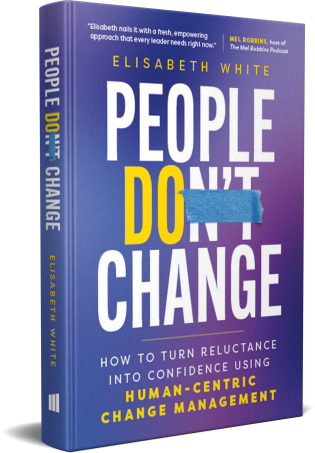
We didn't license a change model. We wrote one.
Human-Centric Change Management is the framework at the heart of People Do Change: How to Turn Reluctance into Confidence Using Human-Centric Change Management, by our Co-Founder & CEO, Elisabeth White. It starts from an unfashionable premise: your people are not obstacles to the transformation. They are the transformation.
This is not a slide deck we bought — it's a method we wrote, teach, and run inside real engagements at credit unions, banks, insurers, and federal agencies. The book is on shelves. The framework is in production.
…a fresh, empowering approach that every leader needs right now.
Mel Robbins — endorsing People Do Change
Built for rooms where "because we said so" doesn't work.
Regulated organizations can't force change through — examiners, auditors, and member trust see to that. HCCM was built for exactly those rooms.
Leaders holding a mandate
You've been asked to transform an organization that has watched initiatives come and go. You need adoption you can show your board — not a rollout you can announce.
Transformations losing steam
The framework went in, and the energy is leaking out. HCCM finds the reluctance, names it, and works it — before the quiet reversion sets in.
Organizations bracing for change
New core system, new structure, new ways of working — the change is coming either way. Arriving with a human-centric plan beats apologizing afterward.
The shape of the work.
Every engagement runs on the Blueprint, our six-step methodology. Inside it, the HCCM work takes four forms — sized to your organization, from a focused readiness assessment to a full change program.
- Readiness assessment
- Evaluate your organization's readiness for change — who's eager, who's wary, and why — before anything rolls out.
- Change network
- Build a network of champions inside your own walls, so the change has local voices — not just visiting consultants.
- Adoption measures
- Define what "adopted" actually looks like, then measure it — behavior, sentiment, and delivery, not attendance sheets.
- Sustainment
- Establish and support a sustainable pace for your transformation, so the new way is still standing long after we leave.
Every TTCU employee. Not most — every.
At TTCU Federal Credit Union, human-centric change wasn't a workstream on a slide. Every employee completed the Agile&Me foundational workshop, and 100% of ART members were given access to development workshops and certification courses.
When people are brought along instead of dragged along, it shows up in the numbers. By Q3, TTCU's Agile Release Train reported team-health scores most transformations never see — while value delivery predictability climbed from 60% to 100% in the same twelve months.
The full story — with named, on-the-record endorsements from TTCU's President & CEO and executive team — is in the white paper. The numbers live in the case study.
The Cornerstone Agility team was the breath of fresh air we needed on our company's Agile journey.
Director — Fortune 500 Financial Services
Change sticks when the learning keeps coming.
Adoption is a habit, and habits need reinforcement. We pair every HCCM engagement with training that meets people where they are — starting with the workshop every TTCU employee completed.
Agile&Me
Where every TTCU employee started.
The foundational workshop that gives every person — not just delivery teams — a working grasp of Agile and their own place in it.
Explore Agile&MeWorkshops & Custom Sessions
Built around your change, not our slides.
Custom workshops that reinforce the specific behaviors your transformation depends on — designed with your change network, run by our instructors.
Browse workshopsThe Bookshelf
Four published titles. Free expertise.
People Do Change and two field guides — for the practitioners carrying the change between sessions.
Visit the bookshelfPeople do change. Let's prove it.
Thirty minutes with a founder — not a sales team. Bring the change your organization is dreading, and we'll talk about how to make it the one your people actually adopt.